
Work & Examples
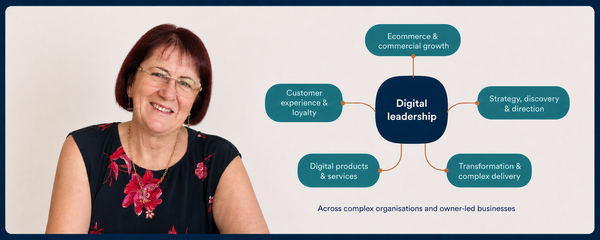
Selected examples of digital leadership across ecommerce, commercial growth, product development and complex transformation
My work usually begins with an important question, an unclear problem or a business ambition that has not yet been turned into something deliverable.
I work across customers, operations, commercial priorities and technology to establish what is actually needed, bring the right people and decisions together, and create a practical route forward. These examples are not an exhaustive career history. They show the kinds of problems I have been trusted to solve and the results that can follow.
Building online grocery from the ground up
New World Online
As programme manager for New World Online, I turned Foodstuffs Wellington’s board-level commitment to online shopping into an executable programme.
Starting without a business case, selected platform or established delivery structure, I researched the supplier market, wrote the business case and RFP, managed the competitive selection process and mobilised a multidisciplinary team. MyWebGrocer was selected as a proven, configurable online-grocery platform, allowing Foodstuffs to concentrate on establishing the commercial and operational capability around it rather than designing an unfamiliar service from scratch.
The programme crossed more than nine business and technology workstreams and required approximately 17 system integrations, including product and store-specific pricing data, stock management, point of sale and payments.
Much of the complexity sat beyond the website. We had to turn ordinary grocery-shopping behaviour into workable digital and store processes: products sold by weight or by item, estimated and final order values, substitutions, unavailable products, picking efficiency, refrigeration, staging, collection and delivery. Practical store trials exposed where time and money could be lost and helped shape the equipment, processes and local ownership needed to operate the service successfully.
I led the Foodstuffs side of delivery, coordinating store operations, marketing, master data, technology specialists, testing and MyWebGrocer’s US-based team.
New World Online entered live production at Thorndon with a functioning store operating model. I transitioned out after handing the service over to the permanent online-shopping and rollout team, with a wider rollout plan in place.
Turning digital channels into commercial growth
Origin Pacific / Chathams Pacific / Air Chathams
At Origin Pacific, I initially worked in yield management, learning how load factors, fare structures and unsold inventory affected the economics of each flight. After being appointed Marketing Manager, I led the reconstruction of the airline’s brochure-like home page around the two things customers most needed: booking a flight and seeing what was on sale.
The change produced an immediate lift in online sales and reduced avoidable calls to the booking centre. I then brought together colleagues from yield management, commercial, development and design to create Go Lucky—a deliberately simple way to sell seats that might otherwise have flown empty. Across the home-page work and Go Lucky, the proportion of sales made online rose from approximately 34–36% to 76% within seven months.
Following the collapse of Origin Pacific, I joined a small, experienced team establishing Chathams Pacific after the Kingdom of Tonga invited Air Chathams to operate its domestic air service. The first sales operation consisted of a laptop, a mobile phone and a simple website announcing the timetable and telling customers to ring me to book.
Through my business, Virtual Kiwi, I later worked with web developers and the airline’s reservation-system specialists to deliver Chathams Pacific’s customer website with integrated online booking. I managed the delivery, developed the structure and content, sourced photography and helped translate schedules, destinations, fares and travel products into a functioning digital sales channel. Within approximately two years, the airline was carrying around 65,000 passenger journeys annually across Tonga’s domestic network.
I was subsequently commissioned to deliver the Air Chathams website for its New Zealand operation. That work had to connect mainland travellers—who expected to research and book online—with an airline call centre, operational team and island community working with extremely unreliable internet access.
I also collaborated with Chathams Pacific’s marketing and commercial managers to reposition the Kingdom Pass after its original wholesale route to market failed. Together, we turned it into a product travellers could buy directly through the public website. Implemented for less than $1,000, the relaunched pass generated $24,000 in sales within six weeks and continued to produce revenue for the airline.
Taking a digital service from concept to operation
SafePlus Online Tool
At WorkSafe New Zealand, I was the ICT Project Manager responsible for delivering the SafePlus Online Tool—a free self-assessment service that enabled businesses to gather confidential feedback from leaders and workers, understand their health-and-safety maturity and identify priorities for improvement.
When I joined, the business case and broad product concept existed, but delivery was still at the procurement stage and the project team had experienced substantial disruption. Working closely with the project’s Business Analyst, I led the RFP to market, supplier evaluation and commercial negotiations, followed by the development of a joint delivery plan with the selected development partner, now known as Ackama.
Development began from an existing product foundation, but SafePlus required substantial redesign and redevelopment to accommodate its specialist content, assessment logic, reporting and operational requirements. I led the WorkSafe side of delivery across vendor management, project governance, quality assurance, testing, release planning and transition into operation.
The health-and-safety content and methodology remained in the hands of an expert industry panel, supported by an exceptional Business Analyst and tester who helped translate it accurately into the product.
I led the external industry engagement for beta, pilot and user-acceptance testing: recruiting participating businesses, organising the engagement, supporting participants, coordinating feedback and ensuring that what we learned flowed back into delivery. Industry specialists led the substantive health-and-safety discussions; my responsibility was to make the engagement work and understand what its findings meant for the product.
SafePlus progressed through beta, pilot, UAT and production release before I formally handed it over to its WorkSafe business owner. The online tool launched publicly in September 2018 and remained in operation until June 2025.
Bringing order to difficult delivery
Kōtare gambling licensing and regulatory system
At the Department of Internal Affairs, I inherited practical leadership of the five connected workstreams delivering Kōtare, its $6.6 million core gambling regulatory solution.
The programme was already affected by schedule delay, contractual difficulties, constrained specialist capacity and significant supplier risk. I led delivery across licensing, compliance, data migration, fees and financial integration, including interfaces with the existing electronic-monitoring environment.
We made deliberate scope decisions to achieve a viable production release. Kōtare went live and entered operational use while I was leading the programme.
I subsequently led its operational and financial transition. Working with Finance and other specialists, I established the ongoing operating and software-development budget, converted deferred functionality into a funded backlog, and helped shape the governance and delivery arrangements for continued improvement. Larger future capabilities—including an industry self-service portal—were treated as separate projects.
This work reflects a recurring part of my experience: taking practical responsibility for difficult delivery, making the trade-offs visible and getting an operational service across the line without disguising what still needs to be done.
Connecting digital ambition with business reality
Virtual Kiwi
Through Virtual Kiwi, my digital consulting and delivery business, I worked with smaller businesses on website strategy, solution design, content, search, digital marketing, analytics and supplier management.
I also developed and delivered practical workshops for business owners through organisations including New Zealand Trade and Enterprise and Chambers of Commerce. Topics included website fundamentals, digital growth, search visibility, domains and attracting useful traffic.
Platforms and customer behaviour will continue to change. The questions that keep the response grounded are more enduring:
- What is the business trying to achieve?
- What does the customer need?
- Which activity will genuinely make a difference?
- What should the business do itself, and where does it need specialist help?
- How will all the parts connect?
What connects the work
Across these and other assignments—including several with Loyalty New Zealand—I have returned to three principles: keep customer value visible, work in useful increments, and use only as much delivery machinery as the problem requires.
Digital work becomes unnecessarily difficult when organisations separate strategy from execution, technology from operations or delivery from the people expected to use what is produced. My role is often to reconnect those parts and establish a proportionate way forward.
The work I am interested in now
I am particularly interested in work where strategy and execution are not joining up—or where a business knows something needs to change but has not yet established the right answer.
That might include:
- clarifying a digital opportunity, problem or investment decision;
- assessing an existing digital operation, customer journey or supplier arrangement;
- shaping a product, service or programme and establishing its priorities, roadmap and measures;
- introducing AI with a clear business purpose, appropriate boundaries and realistic expectations;
- recovering work that has become fragmented, stalled or unnecessarily complicated; or
- bringing owners, operational teams, technical specialists and suppliers together around a practical route forward.
I do not pretend to be every kind of specialist. My value lies in understanding the wider problem, asking the questions that expose what matters, connecting the right expertise and helping turn intent into practical action.
Have something that needs untangling?
If you have an important digital question, an opportunity you are trying to shape or work that is not joining up as it should, I would be pleased to hear about it.