
When your digital tools stop earning their keep
Digital tools drift. Hidden capability, ageing software and knowledge held by one person can quietly cost a business time, money and opportunity.

Businesses change. People change. Software changes.
What is different now is the speed.
New capability appears inside tools you already use. Pricing changes. Staff come and go. Workarounds become permanent. Another system gets added because someone needs to solve a problem now, not six months from now.
Along the way, the business can quietly lose sight of what it already has, what it is paying for, and what those tools are now capable of doing.
That gap costs money, time and opportunity.
It can mean buying something you do not need, missing capability you already own, carrying tools that stopped earning their keep, or creating digital litter that nobody quite knows how to untangle.
And when people are working under pressure, those gaps have a habit of turning up somewhere more important: in the customer experience, in a missed opportunity, in a delayed decision, or in somebody’s already overloaded working day.
Sometimes, before adding something new, it is worth looking under the bonnet again.
Digital litter
A messy digital environment is the natural outcome of time, people and software change.
It happens gradually.
A tool is added to solve an immediate problem. Another is retained because someone still uses one feature. A workaround becomes permanent. Someone leaves, and the knowledge of why a system was configured that way leaves with them. New capability appears inside existing software, but nobody notices because everyone is busy getting the work done.
None of those decisions is necessarily wrong on its own.
But over time, the business can end up carrying a collection of tools, subscriptions, workarounds and half-used capability that no longer reflects how it actually operates or what it now needs.
That is digital litter.
And unlike the pile in the storeroom nobody touches, this stuff still costs money and still gets in people’s way.
The consequences accumulate quietly
Duplicate subscriptions. Manual workarounds. Repeated searching. Avoidable handoffs. Capability nobody knows exists. Time spent persuading an ageing system to do something it was never really designed to do.
Some of the most important capability may not sit inside a formal system at all.
It may live in a spreadsheet only one person understands. In a workaround nobody documented. Or in the head of the person everyone calls when something goes wrong.
That is useful capability right up until that person leaves, changes role, goes on holiday, or simply has too much else to do.
Duplication can be just as difficult to see.
The business may be paying for the same capability in more than one tool. It may buy another tool because nobody realises an existing one can already do the job. Or it may continue paying for software that made perfect sense once and now survives largely because nobody has stopped to question it.
The opportunity cost matters too.
Time spent navigating unnecessary complexity is time not spent improving the customer experience, solving the real problem, or moving the business forward.
Look under the bonnet again
Looking again does not have to be complicated.
For a smaller business, it may be a simple inventory. For a larger one, it may need a more structured review. Either way, the purpose is the same: understand what capability the business actually has today.
And that means looking beyond the software licence list.
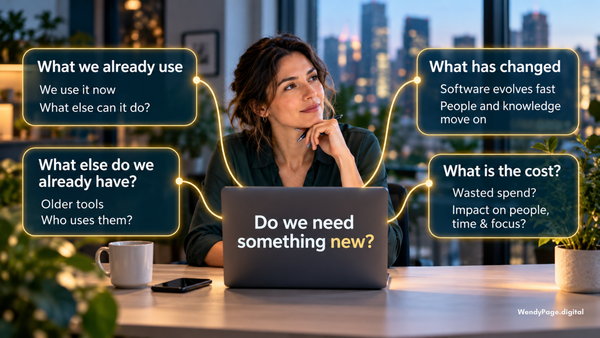
What tools are being used? What are they being used for? What are they costing? What capability has appeared since they were first introduced? Are some now expensive for what they deliver, or simply showing their age against newer alternatives?
How well are they working for the people who use them? Who knows how to use them well: one person, or several? Where are people relying on workarounds, spreadsheets or individual knowledge to keep things moving?
A simple inventory can surface duplication, forgotten capability, unnecessary cost, ageing tools and areas of risk surprisingly quickly.
The point is not to tidy for the sake of tidiness.
It is to make sure the business still understands the digital environment it is relying on.
Once you can see what is there, the next decisions become easier.
Sometimes the answer will be to use more of what you already have. Sometimes it will be to retire something. Sometimes the right answer really is to buy something new.
The point is to know why.
Keep the picture current
The inventory does not need constant attention, but it should not be allowed to go stale.
Someone close to each major tool or area of capability should keep an eye on meaningful changes.
If a platform adds capability that could solve an existing problem, that is worth surfacing. If pricing changes materially, that is worth knowing. If a tool is becoming harder to support while better alternatives are appearing, that matters too.
This does not require somebody spending hours every week reading release notes.
Most updates will not matter.
The useful question is much simpler:
Has anything changed here that matters to us?
That is enough to stop yesterday’s understanding of the digital environment quietly becoming tomorrow’s problem.
Looking under the bonnet is a business issue
Left alone, digital environments drift.
Eventually, the cost shows up somewhere.
In unnecessary spend. In slower work. In duplicated effort. In missed capability. In increased dependency on one person. In an employee wrestling with a tool that everyone knows is awful but nobody has quite got around to replacing.
People carry part of that cost every day.
They work around ageing tools, fill gaps manually, remember what nobody documented, and keep things moving when the digital environment no longer fits the job.
The business pays too.
It pays in salaries spent on avoidable work. In software that no longer earns its keep. In mistakes, delays, missed opportunities and customer experiences that are harder than they need to be.
None of this necessarily arrives as one dramatic failure.
It accumulates quietly until the business is paying for complexity it no longer properly understands.
Looking under the bonnet from time to time is not about keeping everything tidy.
It is about making sure the tools, knowledge and capability the business relies on are still earning their keep, still working for the people expected to use them, and still helping the business move forward.
Written by