How to let AI make stupid mistakes without allowing it to make expensive ones
AI needs somewhere safe to be wrong. Start with a pilot, set the boundaries and stay close enough to keep stupid mistakes from becoming expensive ones.

AI needs somewhere safe to be wrong.
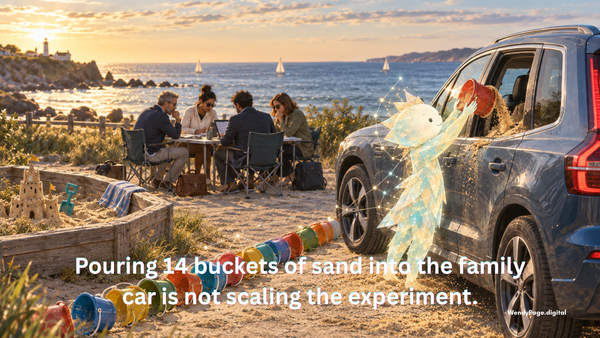
Think of it as a small child in a sandpit: enthusiastic, inventive, startlingly quick—and entirely unaware that pouring fourteen buckets of sand into the family car is not “scaling the experiment.”
That is why we start with a pilot.
You choose a safe place to play. You provide the bucket and spade. You explain a few simple boundaries. Then you stand close enough to intervene without taking over every sandcastle.
You do not need a Sandcastle Steering Committee before anyone is allowed to touch the sand.
But you are still the responsible adult.
Being the responsible adult is not especially complicated. You need to know where the play area ends, what the AI may see and touch, when a human must take over, how much mess you are prepared to clean up, what would end the experiment—and what must be true before it is allowed out of the sandpit.
Inside those boundaries, let the AI make stupid mistakes.
Let it misunderstand the question. Let it mangle a spreadsheet. Let it invent a policy, develop strong opinions about Susan from Accounts and draft a customer email beginning, “Greetings, valued biological stakeholder.”
Laugh. Correct it. Learn what it is good at—and what it absolutely must not be trusted with.
Eating the sand is an undocumented use case.
Throwing it at another child is an incident requiring review.
Buying a mechanical digger is not “accelerating adoption.”
Removing the fence is not “empowering innovation.”
Leaving the children unsupervised is not “decentralised decision-making.”
And fourteen buckets of sand in the family car is still not scaling.
The trouble begins when the experiment is quietly given access to live customer data, a company credit card or permission to press Send.
At that point, the AI has not suddenly become the responsible adult.
You have simply stopped paying attention.
The purpose of a pilot is not to prove that AI is clever. It is to discover where it is useful, where it is unreliable and what protection it needs before its mistakes can escape into the business.
Because AI does not know where the sandpit ends.
It does not know that the tide is coming in.
And it certainly does not wish to be washed out to sea while all the responsible adults are in a meeting discussing innovation.
Give AI the freedom to make childish mistakes.
Just stay close enough to ensure they remain inexpensive ones.
Written by
What's Next?