

AI can make customer service easier. Unless...
AI can make customer service faster and easier. But good automation needs clear boundaries, escalation and handoff when the customer needs something more.

Customers want easier ways to get things done. Businesses want better ways to serve them. AI can deliver both.
It can answer routine questions, operate outside business hours, help customers find information and resolve simple requests without waiting for someone to.
For the customer, that's convenience. For the business, it's capability, availability and efficiency.
Done well, everybody wins.
The trouble starts when an efficiency for the business becomes work for the customer.
The business records an efficiency. The customer records an experience.
Good automation removes work.
If I want to know whether you're open tomorrow, whether something is in stock or how to return something I've bought, let me find out immediately.
I don't need human connection. I need an answer.
But automation can also transfer work.
A simple interaction becomes find the phone, scan the code, navigate the interface, create an account, remember the password, explain the problem to a chatbot and eventually discover that none of the available options quite fit.
The business may have made the interaction more efficient.
It has also made some of the service my job.
That's the point where we need to stop asking whether an interaction can be automated and start asking:
What problem is the customer actually trying to solve? And who is best placed to deliver that?
Good automation knows its boundaries.
Some customer needs are straightforward.
Others become complicated very quickly.
“Do you have gluten-free options?” is a very different question from “I have an allergy. Can this particular dish be safely modified?”
A customer asking a routine question may be delighted to get an immediate automated answer.
That same customer may be equally delighted when the system recognises that the next question needs somebody with the context, judgement or authority to resolve it.
Good customer service already works this way.
Businesses have escalation paths because not every person can resolve every problem. Someone handling bookings may not be authorised to approve a refund. A frontline employee may need to involve a manager.
AI is no different.
It needs a clear boundary around what it can resolve well, and a clear path onward when it can't.
The objective isn't maximum automation.
The objective is to solve the customer's need well.
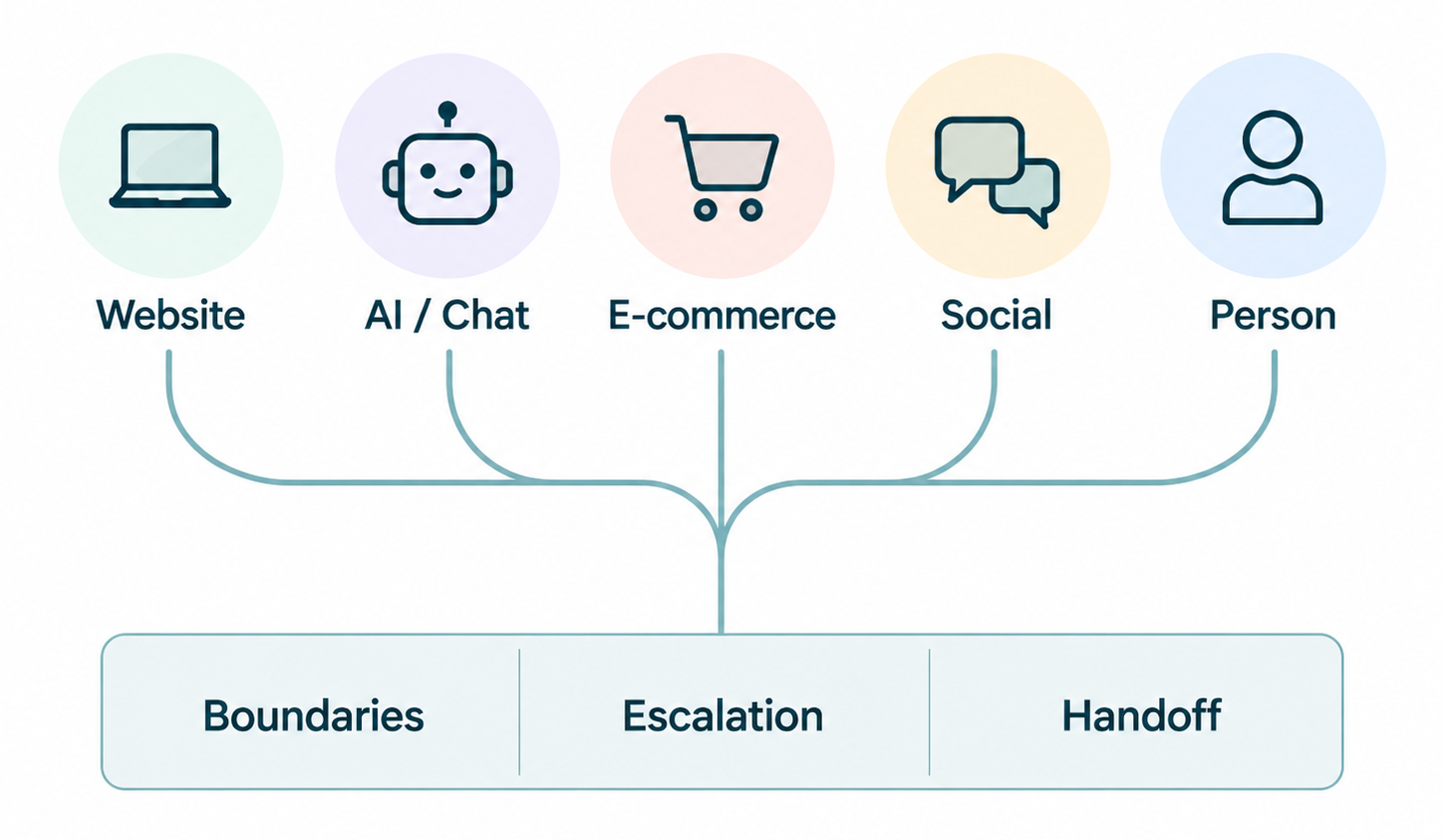
Make the handoff part of the service.
When automation reaches its boundary, it needs a clear escalation path.
The customer may already have explained the problem, answered questions and tried several options.
Don't make them start again.
The context needs to travel with them.
If a human isn't available immediately, the AI should set expectations: what happens next, when the customer should expect a response and how they can follow up.
A successful handoff is part of successful automation.
This is where AI strengthens the human contribution rather than replacing it.
Equip the human with the context already gathered, the interaction so far and the information they need to take over.
The customer shouldn't have to bridge the gap between your AI and your people. The business should.
Saving money can become expensive.
Poor automation doesn't always announce itself as a service failure.
Customers don't necessarily tell you that your chatbot irritated them, your ordering process created unnecessary work or they couldn't reach a person when they needed one.
They abandon the purchase.
They take their business somewhere else.
They don't come back.
And they speak that experience into the world:
To a colleague. To a friend. In a review. In a recommendation.
Commercial damage can arrive as a thousand tiny shrugs.
That's what makes it easy to miss.
The business can see reduced handling time, lower staffing costs or more interactions automated.
It may be much harder to see the customers who took their business elsewhere.
A service efficiency isn't a commercial win if it weakens the customer relationship.
Before you automate the customer interaction
AI gives businesses real opportunities to make service faster, easier and more useful.
Take them.
But success isn't measured by how much human interaction you remove. It's whether the customer's need is resolved well, how easy you were to deal with, and what that experience does to the relationship.
Understand the problem the customer is trying to solve. Know what the AI can handle well. Set its boundaries. Build the escalation path. Make sure the context travels when a human needs to take over.
Good automation should make it easier to deal with the business, not harder to reach it.
Then ask:
Are you removing friction for the customer, or transferring it to them?
How will the customer speak about this experience afterwards?
Written by