
AI and the Future of Work: Writing the Playbook as We Go
Nobody has a definitive playbook for AI and the future of work. Why businesses need to protect existing expertise while learning, adapting and implementing AI responsibly.

Nobody has a definitive playbook for how AI will change work.
Not the companies developing the technology, not the organisations adopting it, and certainly not the people wondering what it means for their jobs.
Yet businesses are making decisions today, including decisions about productivity, investment and the future of their workforce. Some of those decisions rest on AI capabilities that haven't been proven within the business.
We've navigated profound technological change before. Industrialisation, electrification, computers and the internet reshaped businesses and livelihoods. Some occupations disappeared, others emerged, and many changed beyond recognition.
But AI presents a different challenge. Its capabilities are developing rapidly, extending into work previously dependent on human expertise. And the boundaries of what it can do keep moving. Even the technology delivering those capabilities may be superseded.
We can make predictions. What we cannot confidently predict is how this will play out across individual businesses, jobs and industries.
So before banking anticipated productivity gains or deciding which roles AI might replace, there's an existing asset worth examining closely: the expertise already in the building.
The people who understand your business will help you navigate what comes next.
Work is changing, but not uniformly
Professor Ethan Mollick describes AI's uneven capabilities through a concept called the Jagged Frontier.
AI may perform exceptionally well at a complex task and then struggle with something apparently straightforward. Those boundaries shift as models improve and new technologies emerge.
A job isn't a single activity. It comprises tasks, decisions, relationships, responsibilities and knowledge accumulated through experience.
AI may perform some tasks faster or better than people, while others remain difficult to automate. New activities may emerge as existing ones change.
Some jobs will disappear. Others will be created. Many more are likely to be substantially reshaped.
But those broad observations tell you remarkably little about what should happen in your own business.
That requires understanding the work, what makes it valuable and the capabilities needed to sustain it.
The expertise already in the building
Your people know things about your business that may never have been fully documented.
They understand customers, operational processes, exceptions, dependencies and the peculiarities that don't appear in a procedure manual. They know which apparently simple tasks conceal considerable complexity.
Imagine introducing AI to produce a complex management report.
The technology may be perfectly capable of assembling information, analysing trends and presenting findings. It might even uncover inconsistencies the business hadn't recognised.
But was it given the full remit, complete data and sufficient context to interpret the findings correctly?
A convincing report isn't necessarily a reliable one.
And even when AI identifies a genuine problem, discovering it is not the same as understanding its commercial significance or deciding what should happen next.

The employee who previously prepared that report may contribute far more than its production. Their experience may be essential to understanding the findings and how they inform decisions.
This is where the commercial risk becomes significant.
A business could restructure its workforce around anticipated AI productivity gains, only to discover that the technology underperforms, the savings don't materialise or the implementation creates additional work.
Six or twelve months later, the technology may have changed substantially. A model may have been superseded, a capability delivered differently or an established process require reworking.
What happens if you've already lost the expertise needed to navigate those changes?
Don't discard the knowledge you need to navigate the change.
This isn't an argument for preserving every existing role unchanged. It's an argument for understanding what your people contribute before making consequential decisions about replacing their work.
The employees who help operate your business today may also be among those best equipped to shape how AI operates within it tomorrow.
Delegation isn't abdication
Recognising the importance of human expertise doesn't mean keeping people involved in every AI-driven activity.
As AI agents become capable of undertaking more complex work, constant human intervention may become unnecessary or even counterproductive.
Greater autonomy doesn't eliminate accountability.
AI already evaluates options, makes choices and exercises forms of judgement. Simply insisting that humans must provide the judgement is no longer a sufficient description of their role.
The questions are more practical.
What can AI reliably undertake? Which decisions require human involvement? What should trigger an escalation? And who remains accountable for the results?
The answers depend on the work, the maturity of the implementation and the consequences of getting something wrong.
Stepping out of a process is not the same as stepping away from responsibility.
Someone still needs to understand what the process is intended to achieve, how it is performing and when it needs to change.
That is stewardship.
It may involve direct supervision, periodic review, managing exceptions or reconsidering how work is organised. As AI capabilities evolve, the appropriate form of stewardship may evolve with them.
Your playbook will keep changing
Nobody can give you a definitive blueprint for how AI should reshape your business.
You'll need to develop your own understanding of what's possible, what's useful and what you can responsibly put into practice.
That doesn't require sending everyone on a generic AI course.
It means giving people opportunities to examine their work with a better understanding of AI, explore relevant applications, contribute their expertise and develop the capabilities they need.
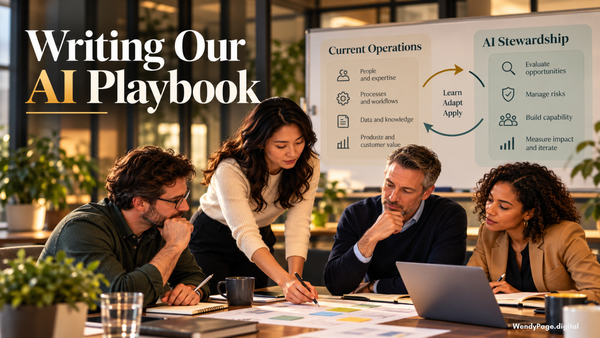
Awareness, exploration, capability development and responsible implementation are interconnected. Experience in one informs the others.
An experiment may uncover a weakness in existing information. Addressing it may create new opportunities. An implementation that works well today may need reassessment as technology or business requirements change.
Sometimes it makes sense to proceed. Sometimes to change direction. Sometimes to stop.
A decision made with the best available information today may need reconsideration in six months. That doesn't mean it was wrong.
The purpose of your playbook isn't to establish permanent answers. It's to help your business keep learning, making informed decisions and adapting while retaining responsibility for outcomes.
Implementation is not the finish line.
Participation offers agency
None of this removes the uncertainty facing people whose work may change.
For someone worried about their livelihood, the promise of future opportunities elsewhere offers little comfort if their current job is at risk.
We shouldn't pretend that embracing AI guarantees employment or that everyone affected by technological change will benefit from it.
History provides perspective, but it doesn't promise a painless transition.
What participation can offer is some agency.
People who understand what's changing, can explore new capabilities and contribute to decisions affecting their work have greater influence over what happens than those left watching change unfold around them.
Businesses benefit from that participation too.
Before counting productivity gains or removing existing capability, ask yourself: Do we understand what our people contribute today, and what we'll need from them to deliver and sustain tomorrow's AI-enabled business?
The future of work won't be determined by AI capabilities alone. It will also be shaped by decisions about people, processes and the value businesses choose to pursue.
Waiting for certainty may be the least useful response to a future that refuses to stand still.
There is no finished playbook to follow. You'll have to write your own, learn from experience and keep revising it.
History offers perspective. Participation offers agency. Responsible leadership helps make participation possible.
Written by