
Why do I have to speak wine to buy it?
Wine buyers often know why they're buying without knowing which bottle fits. Better product information and new ways to discover wine create an opportunity to meet them where they are.
A few days ago, I needed to choose a bottle of wine for a weekend away.
I knew exactly what I wanted. It was a surprise for someone special. I wanted something lovely, something that felt right for the occasion, and I was prepared to spend enough to get it right.
I had four wines to choose from.
And absolutely no idea which one to buy.
This wasn't because I didn't know what I wanted. I knew everything that mattered about the purchase. What I didn't have was the product knowledge to translate that into one of those four bottles.
Why should I have to understand your product before you can sell it to me?
Wine has always asked a lot of the person buying it. But the way customers discover products, the information available to them and the technology businesses can use to help them choose have all changed.
Whether that choice is happening in a supermarket, bottle store, restaurant or online, there is an opportunity to make buying wine easier without making wine any less interesting.
And some of the foundations for doing that are already sitting there, ready to be used.
They know why they're buying
Wine makes this problem particularly visible.
Walk into a bottle store, open a wine list or browse an online retailer and you're confronted with extraordinary choice. Varietals, regions, vintages, blends, producers, tasting notes, production methods and awards.
Knowing more about wine certainly helps. But the sheer number of possible choices makes comprehensive product knowledge an unreasonable expectation.
And let's be honest, we're not selling wine only to sommeliers.
Most customers arrive with something much more ordinary. Dinner tonight. A gift. Friends coming over. A celebration. Something special for the weekend. Or simply restocking the fridge and looking for something interesting.
They arrive knowing WHY they're buying. We ask them to know WHAT they're buying.
When the buying experience doesn't help translate that intent into a choice, customers have to rely on other signals.
Price. A familiar brand. A label that catches the eye. Gold medals. A promotion. Something we've bought before. Something we've recently heard about.
None of those are bad reasons to choose a wine. But they may have very little to do with why the customer came looking in the first place.
And that matters because wines sitting comfortably beside each other can deliver very different drinking experiences.
Without enough help to tell the difference, you can spend good money and still end up with a wine that simply isn't right for you or the occasion.
That's also a commercial problem in a category where competition for attention is extraordinary.
There are perfectly good reasons wine is organised the way it is. Retailers need to manage inventory. Someone who knows they want a Marlborough Sauvignon Blanc needs to be able to find one. A knowledgeable buyer may actively want to browse by region, varietal, vintage or producer.
And sometimes wandering is the point. There is real pleasure in discovering something from Portugal, Spain or Argentina simply because it looks interesting.
None of that needs to disappear.
The opportunity is to give customers more ways in, not take any away.
Make full use of the digital shelf you already have
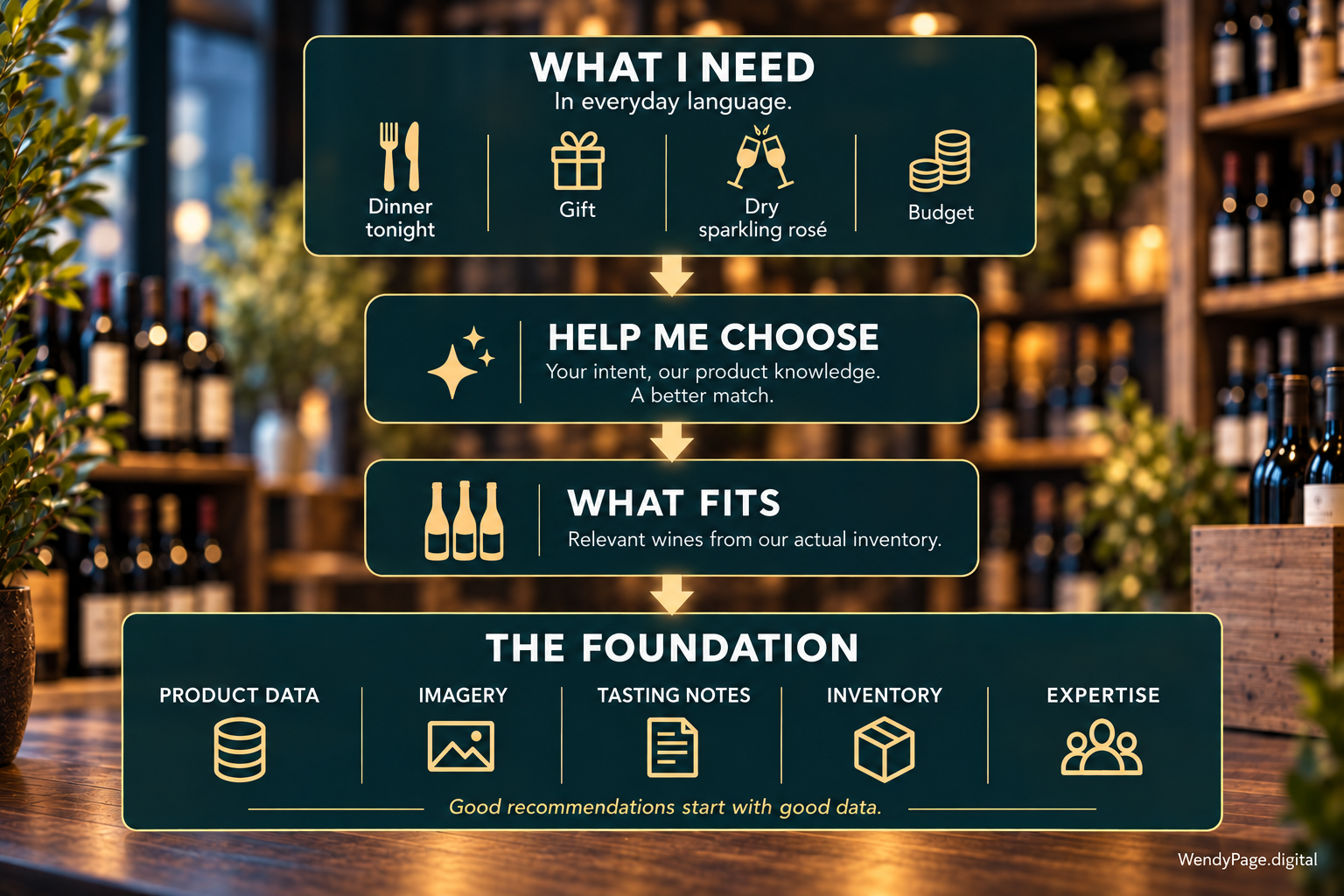
Before we talk about new ways to help customers choose, there is a foundation beneath them: the quality of the product information you make available.
Spend some time browsing wine online and the differences can be striking.
One product has excellent photography, readable front and back labels, tasting notes, food pairings and enough of a story to help you understand what you're considering.
The next has one photograph and a couple of sentences.
That's a lost opportunity.
Wineries already create much of this information. It's on the label, the website, in tasting notes, technical material and marketing collateral. The opportunity is to make sure that useful information follows the wine into the places where people are selling, recommending and choosing it.
The customer buying online can't pick up the bottle and turn it around. A member of hospitality staff trying to answer a question may not know every wine on the list. A retailer can only work with the information you've provided.
The infrastructure for supplying retailers with structured product information, imagery and other digital assets already exists.
And much of the material does too. The photography. The tasting notes. The product information. The story.
Providing it properly to the people and platforms selling your wine is part of doing a complete digital marketing job.
Imagery doesn't have to stop with a competent photograph of the bottle.
Show me the back label. Show me the wine poured. And particularly if you're a smaller producer, show me something of the people and place behind it. The vineyard. The table. The bottle being shared.
That digital shelf can do more than identify your product. It can help somebody understand why they might want it.
Here's the kicker.
If the product record is thin, incomplete or generic, you have made your wine harder to understand, harder to recommend and ultimately harder to sell.
Give customers another way in
Good product information gives us the foundation. Now we can think differently about how customers discover it.
The traditional wine aisle doesn't need to disappear.
If somebody knows they want a Central Otago Pinot Noir, let them go straight there.
But that doesn't have to be the only entrance.
Melbourne retailer Drop Shop took that thinking much further. Rather than organising its range around traditional varietals and regions, it created three wonderfully ordinary buying contexts:
Weekday. Party. Fancy.
The customer doesn't need to know their grape varieties. They need to know why they're buying and roughly what they want to spend.
You don't have to rebuild a bottle store to borrow the thinking.
Retailers already create temporary collections around Christmas, Easter, Mother's Day, specials and other buying occasions. Wine can be merchandised around customer intent too.
Dinner tonight. Taking a bottle. Something special. A gift. Summer drinking. Restocking the fridge and looking for something interesting.
The permanent shelves can stay exactly where they are. You're simply giving customers another way to discover what's on them.
Online, another entrance doesn't even require another shelf. Collections can change with seasons and occasions. A customer can browse by purpose as easily as they browse by varietal.
A QR code can turn the physical bottle into a doorway to richer information, rather than leaving a small label to carry the entire sales conversation.
Now there are opportunities to make that translation more dynamic.
What if I could simply tell you what I need?
I want a sparkling rosé. Something dry and easy drinking. I'm on a tight budget. What have you got?
That's not a search query written in the language of wine.
It's a perfectly good description of customer intent.
AI can provide a translation layer between that everyday-language request and a retailer's product information and inventory.
This isn't hypothetical. Beverage-specific tools already exist that can work with an online store's catalogue and inventory, helping customers find products based on occasion, food, budget or preference.
The point isn't that every retailer needs an AI sommelier.
The point is that this kind of customer-led discovery exists now.
And it isn't confined to an online store. The same principle can support a member of staff or an in-store Help me choose experience.
The customer can describe what they need in everyday language.
The retailer can bring the expertise, people and technology to help them choose.
But the producer still has to provide the product information that makes a useful match possible.
Helping me choose has value beyond the sale
Helping me make a good choice can do more than make a sale.
You've demonstrated your expertise. You've given me a reason to trust you and, perhaps next time, a reason to start with you rather than starting again amongst all those choices.
For smaller producers, there's another opportunity here.
The expertise, personality and story behind the wine can be part of what makes it distinctive. Much of the material needed to show that may already exist: photography, tasting notes, product information, the people and the place.
The opportunity is to bring those things together digitally and put them to work. Done well, they can make a smaller producer easier to understand, easier to buy from and easier to remember.
For any producer, making rich, complete product information available creates more opportunities for customers to understand the wine, trust the choice and know where to come back next time.
Wine is complicated, and that's part of what makes it interesting. But its complexity doesn't have to become a hurdle the customer must clear before they're allowed to make a good choice.
Meet them where they're standing. Let them tell you what they're trying to do. Then help them find the wine that fits.
Written by