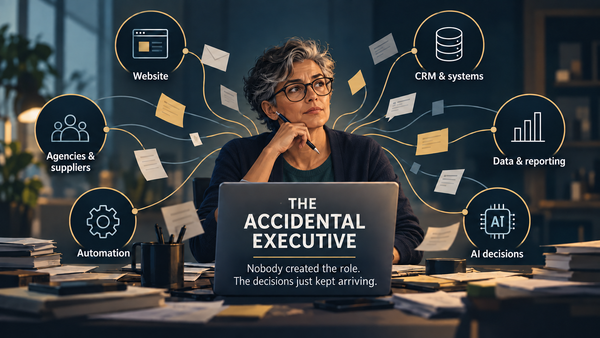

As a competent professional, AI can still catch you out
AI can produce polished, convincing work at extraordinary speed. But professional judgement, context and responsibility still belong to you.

Give it a problem and, within minutes, it can return something structured, articulate and confident. Research summarised. Numbers analysed. Options compared. Recommendations made. A presentation that looks considerably more finished than the time invested might suggest.
For a busy professional, that's enormously valuable.
It's also seductive.
Because when the output looks that good, it's remarkably easy to mistake finished-looking work for finished work.
An accountant can accept an analysis without properly interrogating the numbers. A marketer can present a recommendation without questioning the assumptions behind it. A consultant can take a beautifully reasoned answer into a client meeting without considering the context the AI never had.
Add time pressure and an approaching deadline and the shortcut can become very attractive.
And this isn't simply a risk for people who don't know what they're doing.
The risk applies precisely because you are competent.
You're busy. You're trusted. You have autonomy. You're expected to deliver. You recognise a plausible answer when you see one.
Now you also have a tool capable of producing plausible, polished work at extraordinary speed.
The underlying pressures aren't new. Businesses have been pursuing productivity, lower costs and doing more with less for decades. Professionals have always worked to deadlines.
AI changes the acceleration.
It can remove enormous amounts of time between I need an answer and here is something that looks like an answer.
It also makes it astonishingly easy to move faster than your professional judgement.
Until somebody asks:
Why are you recommending this?
And “that's what the AI recommended” is not an answer.
What are you being paid for?
If you're an accountant, lawyer, marketer, analyst, consultant, project manager or another experienced professional, you aren't being paid simply to produce the document.
The report isn't your professional contribution.
Neither is the spreadsheet, the presentation or the recommendation neatly summarised on page 17.
You're being paid for what you bring to it.
Your experience. Your understanding of the organisation. Your ability to recognise what matters and what doesn't. Your knowledge of the constraints, history and people involved. Your ability to look at apparently sensible analysis and realise something doesn't add up.
And ultimately, your judgement about what it all means.
AI can help produce the work.
It cannot relieve you of the responsibility to think.
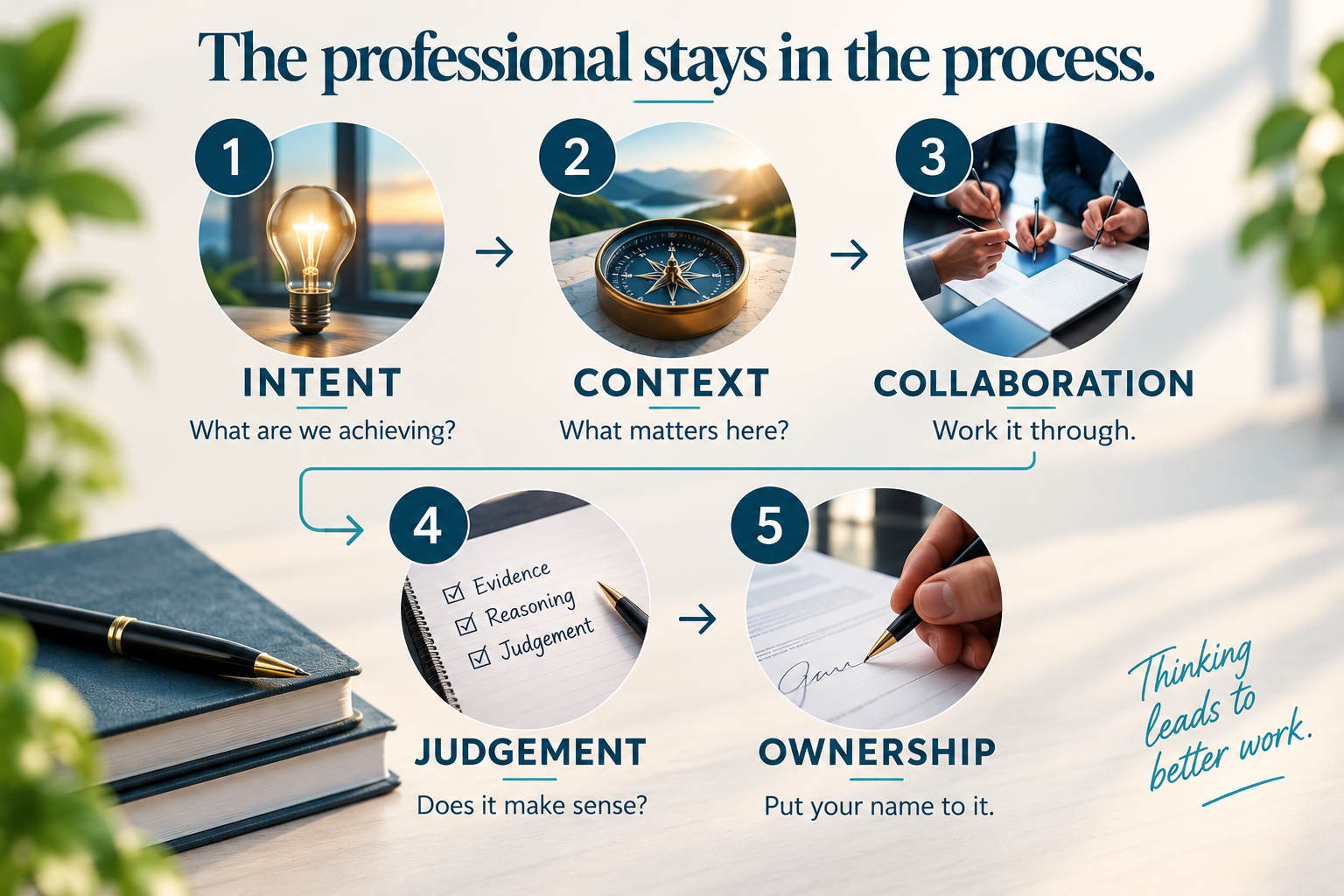
Don't start with AI. Start with the work.
The starting point is the job you need to do.
What are you trying to achieve? What decision needs to be made? Who is the work for? What matters to them? What would a good outcome actually look like?
Only then can you decide how AI might help.
Context matters.
AI doesn't automatically know what management is trying to achieve. It doesn't know the history behind the problem, the commercial realities, the awkward constraint everyone in the business understands, or what happened the last time somebody tried something similar.
If you give AI half the relevant context, it will still do its best to help you.
Worryingly, its best may look magnificent.
That doesn't mean it's sound.
The first answer isn't the work
Professional work with AI should be iterative.
You give it context. It gives you something back. You challenge it. Add information. Question an assumption. Explore another possibility. Tell it where its reasoning doesn't fit what you know. Perhaps it challenges something you had assumed yourself.
That's where AI becomes enormously valuable.
It can help you explore more territory, interrogate more information, test more possibilities and get further in an hour than you might previously have managed in a day.
Take the leverage.
The shortcut is to the work, not around the judgement.
The judgement remains yours:
- Is this accurate?
- What does this mean?
- Does it make sense here?
- What has been missed?
- What would you recommend?
- Why?
The spectacular failures aren't really about AI
We've all seen the AI fails.
Some are hilarious, at least when they belong to somebody else. Professionals have presented invented information, relied on analysis they hadn't adequately examined or discovered rather publicly that a polished AI output wasn't what they thought it was.
It's easy to look at the spectacular examples and think, I'd never do that.
None of this is new. Professionals have always had to interrogate the work put in front of them. Spreadsheets contained errors long before AI arrived. Analysis has always needed scrutiny. Recommendations have always needed judgement.
Human error has always been part of the landscape too.
AI can allow those errors to travel further, faster, and emerge with extraordinary polish.
- Have you accepted an analysis because it looked about right?
- Used numbers you hadn't really interrogated?
- Put a recommendation into a presentation because you were running out of time?
- Accepted a confident answer without asking what context sat behind it?
Now ask yourself what changes when AI makes the work faster and the mistakes harder to see.
The consequences can still be very real.
And some professional mistakes are very difficult to walk back from.
Your reputation has been built over years of education, experience, decisions and work. Depending on what you do, getting something seriously wrong can damage client relationships, credibility, employment and careers.
AI doesn't change where the professional responsibility sits.
It still sits with you.
You know what your job is. Are you still doing it?
This isn't an argument for using less AI.
Quite the opposite.
AI is extraordinary leverage when you remain in control of the work.
Use it to research, analyse, interrogate, challenge, explore, draft, think and add polish to your finished work. Let it remove hours of work where it genuinely can. Let it extend what you're capable of doing.
But don't confuse producing the output with doing the job.
Your employer or client didn't hire you merely to produce a report, spreadsheet or presentation. They hired the knowledge, experience and professional judgement that you bring to it.
If producing the output were all that mattered, there would be considerably less need for you to be involved.
Bring the context. Bring the judgement. Decide what it means.
And when you put your name on the work, own it.
Written by