Your website does not need a secret basement for machines
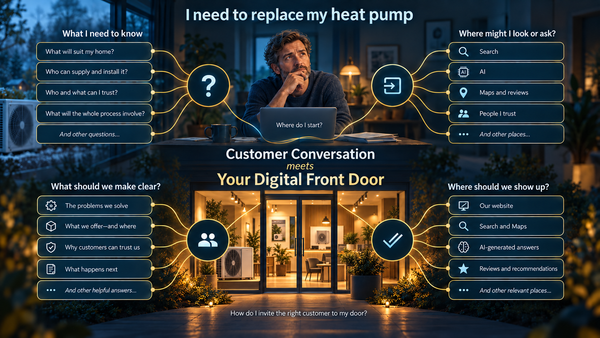
AI may have the first conversation about your business. What it finds across your Digital Front Doors matters.

There is a slightly odd idea creeping into conversations about AI and search.
That businesses now need two versions of their digital presence.
Upstairs, there is the warm, welcoming website for humans. Good photographs. Useful information. Carefully chosen words.
And somewhere underneath it, apparently, we need to build a secret basement full of information for machines.
We don't.
There is technical work involved in making websites easy to find and understand. That isn't new, and it hasn't suddenly become irrelevant.
But the bigger challenge is much more ordinary.
Can a customer, or the technology helping that customer, clearly understand who you are, what you offer and whether you might be right for them?
AI may have the first conversation about your business
Search is becoming more conversational.
Instead of searching for hotels in Singapore, someone can ask for a quiet hotel that suits a couple travelling without children.
Instead of searching for accountants Wellington, they can describe the kind of business they run and ask which accountant might suit them.
That's personalisation in a very practical sense.
The question isn't only “What is available?”
It is increasingly “What is right for me?”
And that conversation may happen before the customer visits your website or contacts you directly.
AI may effectively conduct the customer's first conversation about your business.
It therefore needs something useful to have that conversation with.
Two truths and a hotel full of children
On a recent holiday in Singapore, we stayed at a hotel that had previously been adults only.
It had been adults only for some time. Long enough to build a considerable digital legacy around that identity.
That had changed about two years earlier. The hotel now welcomed families.
We knew it was the sister property of a family hotel next door. We visited its current website and booked directly.
There was nothing obviously wrong with the website. The rooms existed. The facilities existed. The photographs were current.
But it had become rather vanilla flavoured.
It no longer said adults only, but neither did it clearly say we welcome families.
And therein lay the problem.
There were two truths in existence.
The old digital world contained a substantial and perfectly legitimate record of an adults-only hotel.
The current website contained accurate information about the hotel as it exists today, but singularly failed to say who it was now for.
When AI had earlier helped identify the hotel as potentially right for us, that recommendation hadn't appeared from nowhere.
There was a considerable digital history saying adults only, while the current website quietly said hotel.
The old truth was simply much more specific than the new one.
We discovered the missing distinction when the smaller humans arrived.
Your website isn't your only Digital Front Door
Businesses understandably pay a great deal of attention to their websites.
Customers encounter something much bigger.
They may find your website, Google Business Profile, LinkedIn page, social media, directory listings, reviews, photographs, old articles and any number of other traces of your business.
Together, they form your Digital Front Door.
And increasingly, some of that information may also contribute to an AI-assisted conversation about whether your business is right for someone.
That makes four very ordinary qualities important:
Clear. Current. Consistent. Truthful.
They aren't interchangeable.
Your website might be completely current while other important places still describe the business you were three years ago.
Your Digital Front Doors might be wonderfully consistent while consistently repeating something that is no longer true.
And everything you say today can be truthful while still omitting something important enough to change whether a customer thinks you are right for them.
Our hotel demonstrated the last one.
Nothing needed to say, “We are no longer adults only.”
But something needed to clearly tell today's story.
So what do you do about your digital legacy?
This is where it would be easy to create an impossible job.
Businesses change.
Services disappear. Products change. People move. Locations close. Audiences shift. Photographs, reviews, articles and directory listings remain behind.
You cannot scrub the internet clean every time your business changes.
Nor does an old truth automatically become a lie because your business moved on.
There are two useful jobs instead.
The first is digital hygiene.
Look after the Digital Front Doors you can reasonably control. Update the important profiles. Remove stale imagery where appropriate. Correct descriptions and opening hours. Check the directories that matter. Make sure today's website, Google profile, LinkedIn presence and other important entrances broadly agree about the business customers will encounter now.
The second is equally as important.
Build today's digital legacy.
If your business has changed, removing the old story isn't necessarily enough. You may need to tell the new one.
Use current photographs. Publish current information. Describe what you do now. Be specific about who you serve. Keep telling that story clearly and coherently in the places that matter.
If you were known for doing one thing for twenty years and changed direction last Thursday, updating three profile descriptions isn't going to make twenty years of digital history evaporate.
Today's truth needs time and substance to develop its own digital weight.
You don't rewrite your digital legacy by trying to erase your history. You build a stronger current record of who you are today.
Don't create another version of your business for AI
There will be plenty of discussion about optimising websites and content for AI. Some of that work is useful.
But before disappearing into acronyms, technical fixes and new ways of producing content, ask a much simpler business question:
What story does my existing digital presence tell?
And then look across your Digital Front Doors.
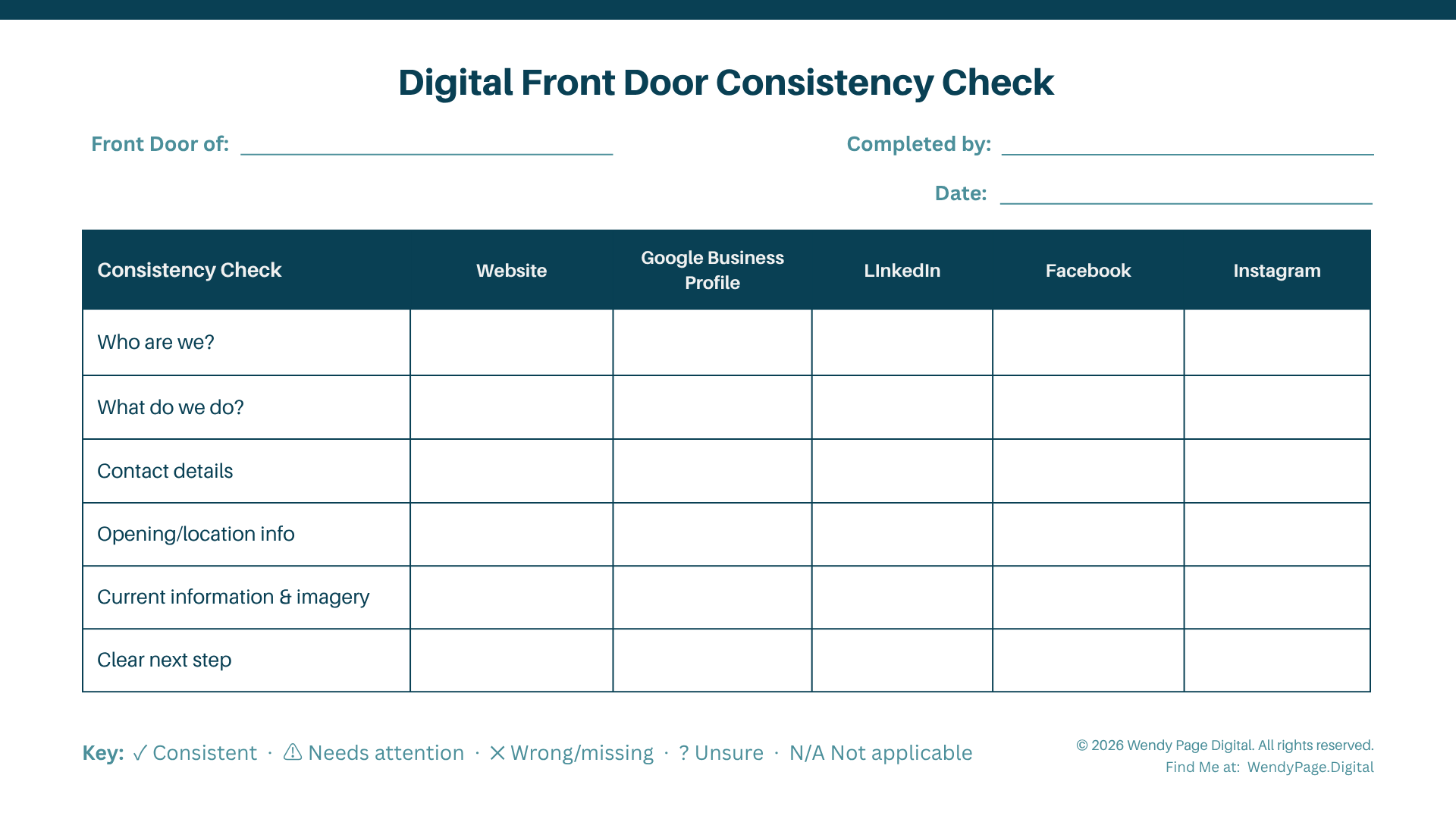
Most importantly, are they specific enough to help someone decide not merely whether you exist, but whether you might be right for them?
AI may increasingly conduct that first conversation.
You don't need warm pages for humans and a secret technical basement for machines.
Give both of them one clear, current, consistent and truthful business to talk about.
Written by