
Search Has Changed. So What?
Search has changed, but good digital fundamentals haven’t. Before chasing new acronyms, inspect the digital front doors your customers already encounter.

It certainly looks as though search has changed beyond recognition.
AI is in our browsers, our search results and the websites we visit. We can ask a question and get an answer without opening ten blue links. We can ask another question, refine what we meant, add another requirement and keep going.
That is a significant change.
But underneath all that visible disruption, rather less has changed than you might think.
The fundamentals of being discoverable have not suddenly become obsolete. Your business still needs to be findable. People still need to understand what you offer. They need reasons to trust you. And, ultimately, the right people need to be able to take the next useful step.
Search has changed. Good digital fundamentals haven't.
Discovery is becoming personal
One of the most interesting changes isn't really about search engines at all. It's about how much easier it has become for us to find something that fits us.
Imagine I'm planning a holiday in Fiji.
I could search for Fiji resorts, open a collection of websites, refine my search, open some more, compare them and gradually narrow the field.
Or I can start a conversation with AI.
I can say I want somewhere quiet. Adults only would be good. Snorkelling straight from the beach matters to me. I'm thinking about June. And through that conversation, I can progressively narrow hundreds of possibilities into a much smaller group that actually fits what I'm looking for.
Someone travelling with three children would have a completely different conversation and, quite rightly, end up somewhere else.
That's powerful.
It also brings us back to something businesses were supposed to understand long before generative AI arrived: know your customer.
Who are you actually for? What problem are you solving for them? What makes your business particularly relevant to their needs?
If technology is getting better at helping people find what suits them, being generically visible isn't necessarily the prize. Being clearly relevant to the right person matters.
What about all those disappearing clicks?
This is where some of the anxiety around changing search becomes understandable.
If Google or an AI assistant answers someone's question directly, that person may never visit the website where some of the underlying information originated.
Website traffic may fall.
Some website visits happened because people had to open a page to retrieve a piece of information. They got what they needed and left. If technology can now supply that answer directly, losing that particular visit may not represent much of a commercial loss.
The more useful question is whether the people who genuinely need what you offer can still discover you, understand why you're relevant and find their way to you.
That puts the emphasis somewhere rather different from simply protecting traffic numbers.
It puts it on relevance.
Unfortunately, there's also a lot of shouting
Try researching what businesses should do about AI and search and you'll encounter an impressive quantity of certainty.
SEO is dead. SEO isn't dead. You need AEO. You need GEO. You need an AI visibility strategy. Everything has changed. You're already behind.
Somewhere underneath all that noise are genuine changes that businesses should understand.
There are also good practitioners doing thoughtful work in a developing field. People are learning, experimenting and adapting as the technology and customer behaviour evolve.
But there are livelihoods attached to it too.
Agencies are changing shape. New services are appearing. Experts need attention. Businesses need customers. And emerging ideas can acquire the appearance of settled fact remarkably quickly when certainty makes for a better headline or a more compelling proposition.
That doesn't make every new service dubious.
It does make it spectacularly difficult for an ordinary business owner, who also has employees, customers, bills and an actual business to run, to answer a much simpler question:
What do I need to care about today?
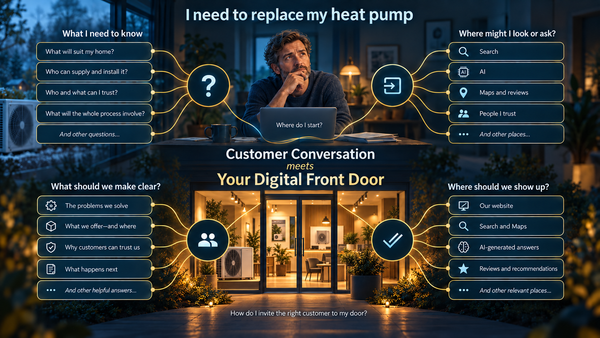
Start with your digital front doors
Before buying a new strategy, learning another acronym or rebuilding anything, I'd start somewhere considerably less exciting.
Go and look at your digital front doors.
Your website may be one of them. So might your Google Business Profile, LinkedIn, Facebook, Instagram or other places your customers encounter you. You don't necessarily get to choose which one they walk through first.
Really look.
Is your basic business information current and consistent across them? Are your operating hours correct? Do your different digital profiles agree with each other? Does your website describe the business you operate today, or one you operated two years ago?
Is your brand presented consistently?
And, importantly, is it clear who you help, what you offer and what problems you solve?
None of this is glamorous new AI-search wizardry. It's basic digital hygiene.
It’s also surprisingly easy for perfectly competent businesses to let their digital presence drift. Somebody changes a service. A project gets launched. Hours change. One platform gets updated and another doesn't. A website page quietly ages in a corner.
Nothing dramatic happens. Digital dust simply accumulates.
So perhaps the arrival of AI everywhere is a useful reason to give your digital front doors a proper inspection.
Not because the old rules have been thrown away.
Because the basics still matter.
So what?
Search has changed enough that businesses should pay attention.
The journey between having a question and making a decision is changing. Discovery can be faster, more conversational and much more personalised. Some searches that once produced website visits won't anymore. The ways businesses become visible will continue to evolve.
But that doesn't mean every business needs to respond with a new programme of activity.
Start by understanding what you already have.
- Can the right people discover you?
- Can they understand what you offer?
- Can they trust what they find?
- Can they take the next useful action?
If the answers are reassuring, excellent. Keep watching how your customers' behaviour changes and resist the temptation to manufacture an emergency because everybody else appears to be having one.
If those questions expose gaps, you have something much more valuable than another alarming headline.
You have somewhere sensible to begin.
Written by