

Why AI implementation is lumpy
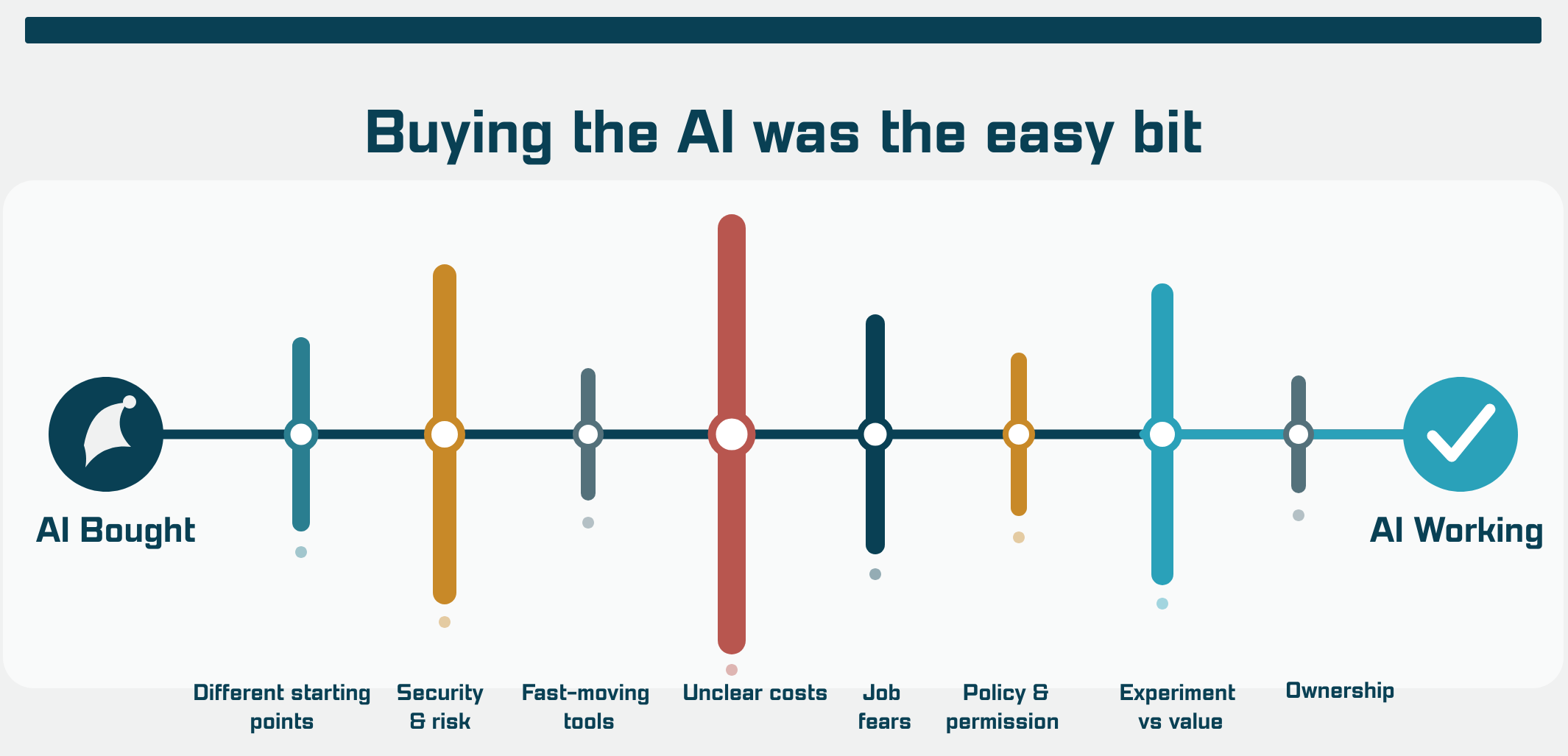
Easy access to AI is not the same as implementation. Inside a business, people, policies, security, costs and workflows make progress lumpy.

AI may be easy to buy, but inside a business it must make its way through people, policies, security, costs and workflows.
Anyone can open an AI account, type a question into a box and get something useful back.
Or something that looks useful.
Before long, a few people inside the business are enthusiastically experimenting, someone has bought several subscriptions and somebody else is wondering whether any of this has been approved.
In other businesses, AI arrives more quietly. A familiar piece of software gains a new AI feature and people begin using it without anyone consciously deciding that the business is now adopting AI.
It can feel a little like the Wild West.
That is not necessarily because leaders are asleep at the wheel. The tools are changing quickly and many of the questions only become visible once people start using them.
But there is a fairly large gap between giving people access to AI and implementing it across a business.
The questions arrive quickly
The first experiments are often simple.
Can AI help draft this email? Could it summarise that document? Can it help with the website or remove some of the boring, repeatable work from a person’s day?
Then the less exciting—but rather important—questions turn up.
- What company information can people put into the tool?
- Can they connect it to their email or other business systems—and what can it access or do there?
- Can they use it from home or through a personal account?
- Which AI tools are approved?
- Where is the information going?
- What are the risks?
- Who is monitoring the cost?
And what happens to those costs once casual experimentation becomes regular use across a business?
These are not reasons to run from the building shouting that AI is too dangerous. They are ordinary business questions about security, access, cost, responsibility and acceptable use.
The difficulty is that businesses are trying to answer them while the technology itself continues to move.
A usage policy written today may need to change as tools gain new capabilities. A tidy per-user subscription may not represent the full cost of heavier use or deeper integration. Something perfectly sensible for creating public marketing material may be entirely inappropriate for confidential customer information.
Even the apparently innocent question, “Can I use AI to help with my email?” is not one question.
It depends on the tool and account, the information in the email, the permissions granted, what the tool can access or do, and what happens to the data afterwards.
No wonder implementation is uneven.
Businesses were never uniform to begin with
People sometimes talk about AI adoption as though an organisation will move forward in one orderly group.
It won’t.
One person may already be using AI every day and building genuinely useful ways of working. Another may have tried it twice, received two mediocre answers and quietly decided it is overhyped. Someone else may be keen but unsure what they are allowed to do.
Different teams have different work, risks and opportunities. The person creating public website content is not operating in the same environment as someone handling employee records, commercially sensitive information or customer data.
Confidence varies. Capability varies. Interest varies.
The usefulness of AI varies too.
Not every role contains a magical pile of work waiting to be handed to a machine. Sometimes the repetitive task everyone wants to automate is attached to an old system, a messy process or a collection of exceptions known only to the person doing it.
This is where the promise of “AI will save time” meets the actual business.
It may save time. It may free people from repetitive work and allow them to focus on the judgement, relationships and knowledge that bring more value to their roles.
But somebody still has to understand the existing work, decide what should change and make sure the new approach does not create a fresh mess somewhere else.
Then there is the fear
Some people are being asked to experiment with a tool they suspect may eventually make their job redundant.
That is hardly an insignificant backdrop to an AI implementation programme.
I am old enough to remember computers being discussed as though they would put everyone out of work.
I also remember the confident arrival of the paperless office. “Nothing will ever need to be printed again” became spectacularly laughable once computers made it easier for everyone to print absolutely everything.
That does not mean concerns about AI and employment are foolish.
Technology changes work. Some roles will shrink, some will disappear and others will emerge. There is no honest reason to pretend otherwise.
But there is a wide stretch of road between “work will change” and “AI is coming for everyone’s job.”
Leaders need to talk honestly about that uncertainty.
If people are worried, acknowledge it. Explain what the business is trying to achieve. Be clear about what is known, what is not known and how employees will be involved.
Asking people to help implement AI while refusing to acknowledge what they may be frightened of is not a particularly promising change strategy.
Nor is treating every hesitation as resistance.
Sometimes the reluctant person understands a risk that the enthusiast has not noticed. Sometimes the enthusiast has found an opportunity that the cautious person cannot yet see.
A business needs both of them in the room.
Then there is the project
At some point, a business has to ask: what will it take to implement this?
Not buy it. Not announce it. Implement it.
That means understanding where AI might be useful in this particular business. It means considering the risks, choosing appropriate tools and getting a handle on likely costs.
It means deciding what people may and may not do. It means training and support. It means fitting AI into real workflows instead of expecting people to invent their own approach around the edges of the working day.
It also means deciding who is responsible.
Who owns the overall direction?
Who approves the tools?
Who creates and updates the usage policy?
Who helps people identify worthwhile opportunities?
Who notices when five teams have bought five different tools to solve much the same problem?
And who checks whether any of it is delivering value?
That is a project. Depending on the size and complexity of the business, it may be several projects.
There may be a pilot in one team, cautious experimentation somewhere else and areas where AI use is deliberately restricted. Some people will move faster than others. Some early ideas will be useful and others will quietly expire after everyone realises they have solved a problem nobody particularly cared about.
That is lumpy.
Some of it is unavoidable. Introducing a fast-changing technology across people, policies, costs, data and workflows that were never uniform was never going to produce one beautifully smooth line on a chart.
The risks are not all on the side of moving too quickly, either. Some uses of AI are becoming practical and commonplace enough that refusing to investigate them is also a business decision.
The aim should not be to eliminate every lump.
It should be to understand why it is there.
A business needs enough direction to know where it is going, enough governance to protect itself and its people, and enough practical support to turn promising experiments into useful ways of working.
AI implementation may be lumpy for a while.
But it should not be accidental.
Written by