

AI Didn’t Publish That
AI can make a draft look finished before the thinking is finished. Someone still needs to check it, question it and decide whether it is ready to publish.

I have been offended by falling editorial standards for years—long before generative AI arrived and gave everyone a new thing to blame.
Once upon a time, newspapers and publishers had editors. A typo appearing in print was treated as a minor crime against humanity. Now we have thrown the editors under the bus, handed the entire publishing process to one overworked person and started calling the results “AI slop.”
I have an objection to that.
AI didn’t publish it.
The problem is not that AI helped to write it. The problem is that a polished draft was mistaken for a publishable one.
It didn’t wake up at three in the afternoon, notice that nothing had been posted that week and panic. It didn’t decide what to write about, produce something vaguely suitable and fling it onto LinkedIn before the next meeting.
A human did that.
Possibly a human who was inexperienced. Possibly one who was too busy. Possibly someone trying very hard to do a good job without really understanding where their responsibility ended and AI’s began.
Or perhaps they did know better and simply didn’t bother. That happens too.
But throwing the label “AI slop” at the finished result tells us very little about what actually went wrong.
Looking finished is not the same as being finished
AI is trained to be supportive and helpful. Ask it to write something and it will have a go.
It may produce a piece that is grammatically tidy, correctly structured and polished enough to look complete. That does not mean it is accurate, useful, interesting or fit for purpose.
AI only improves the work if you put some effort into learning how to work with it.
You need to provide context. You need to understand what you are trying to achieve and why. You need to recognise when something important is missing, when the tone is wrong or when a perfectly respectable paragraph says absolutely nothing.
Garbage in, garbage out still applies. AI has simply become very good at making the garbage look presentable.
That last part creates a new problem. A rough first draft used to look like a rough first draft. Now AI output can look finished long before the thinking is finished.
Someone still needs to critique it.
Someone still needs to check the facts, question the assumptions and decide whether it sounds anything like the business—or the person—whose name will appear beside it.
Someone still needs to sign it off as fit for purpose.
That someone is not AI.
Where did all the editors go?
The old editorial chain was clear.
The author wrote. The editor reviewed. Other people may have checked facts, grammar, layout or legal risk. Not every publishing process was grand or complicated, but there were roles and responsibilities between the first draft and the printing press.
If something dreadful escaped into the world, people knew where the chain had broken.
Now the author may also be the strategist, researcher, writer, editor, proofreader, brand guardian, image hunter, publishing technician and performance analyst.
They are expected to figure out the what, when, how and why—and good luck with everything else.
Then we add AI.
We tell someone it will make them faster. We may give them access to a tool but very little guidance about how to use it. We may not explain what good AI-assisted work looks like or who remains responsible for checking it.
And when the result is poor, we recoil and call it slop.
That feels unfairly simple to me.
It can also be mean.
“AI slop” is such a harsh term. Used carelessly in a workplace, it can become a slap in the face for someone who was genuinely trying to do a good job. It implies laziness and sloppiness, even when the real problem may be inexperience, impossible workloads or the complete absence of an approval process.
It can also be rather convenient for a team leader who supplied no useful brief, offered no support and failed to critique the work before it went public.
The author is still responsible for their part. But responsibility does not begin and end with the person who pressed Publish.
Someone still needs to wear the editor’s hat
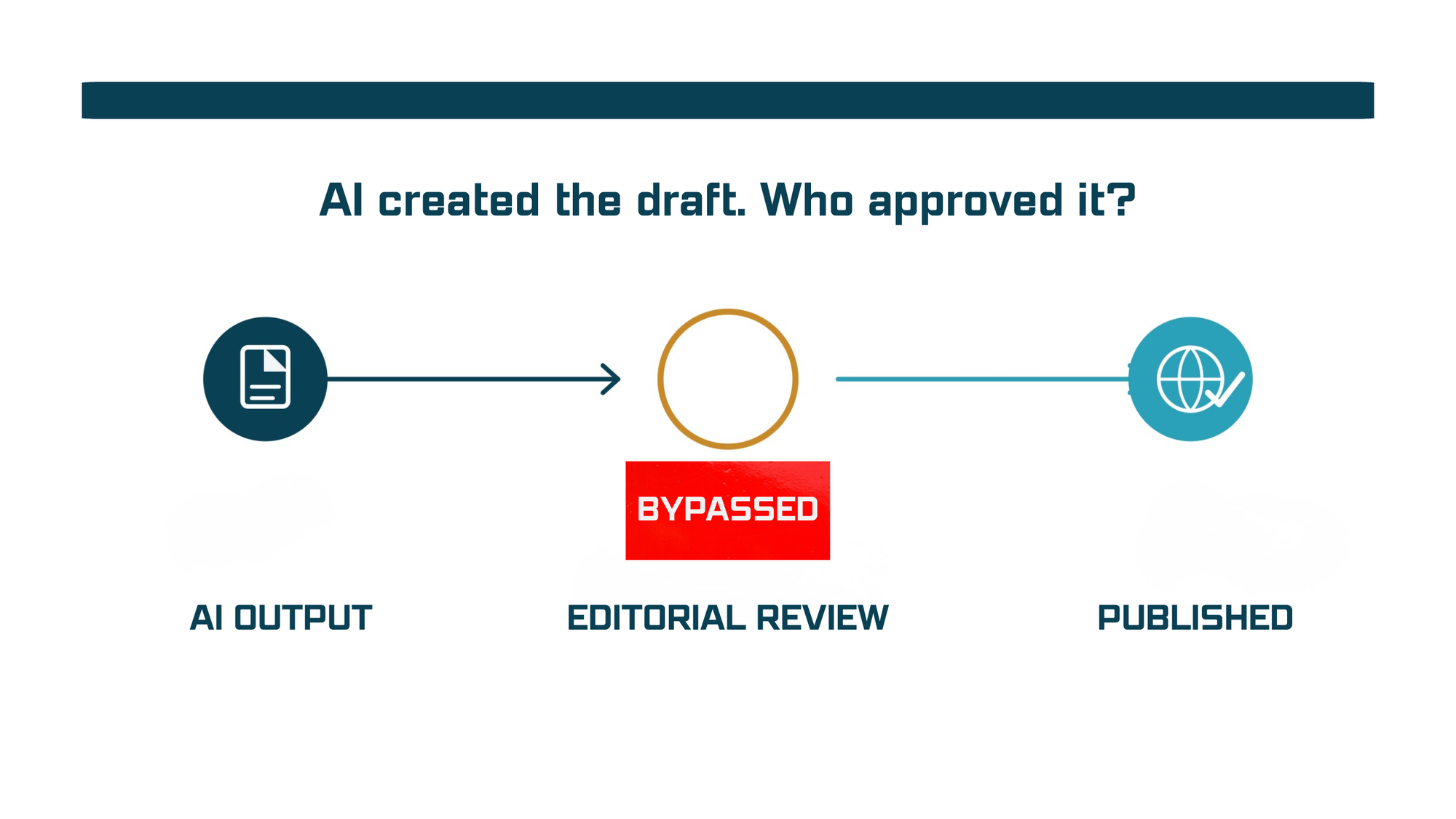
I am not suggesting that every small business rush out and employ an editor.
I am saying that the editorial role cannot simply disappear.
Perhaps another person reviews the work. Perhaps there is a clear approval point. Perhaps a small business owner puts the draft down, makes a cup of tea and returns later wearing the editor’s hat rather than the author’s.
The practical version does not need to be elaborate.
- What are we trying to achieve?
- Who is this for?
- Is it true?
- Is it useful?
- Does it sound like us?
- Are we happy to attach our name to it?
AI can help with those questions, but it cannot carry the final responsibility for answering them.
It can produce rubbish. It can invent facts, flatten an interesting idea and write an entire article in that peculiar voice that sounds confident, competent and completely unlike any human you have ever met.
It is a tool with very real weaknesses.
But it is not holding the steering wheel. It did not decide the purpose, set the deadline, remove the editor or approve the result.
So the next time something is dismissed as AI slop, perhaps we should pause before blaming the machine—or humiliating the human who used it:
- Look at the intent.
- Look at the input.
- Look at the support.
- Look at the process.
- Look for the person who decided it was ready to publish.
Because AI didn’t publish that.
Written by